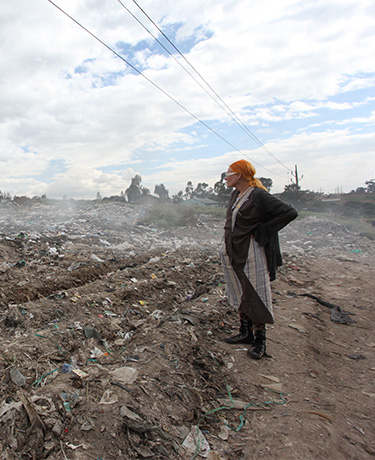
Fashion makes a significant contribution to the growing climate crisis. The exact tonnage of carbon emissions the industry emits remains contested, though the World Bank currently estimates this at 10% of total global emissions.
According to McKinsey , fashion’s current growth trajectory misses the Paris Agreement commitment to limit global warming to below 2 degrees by 2030, by 50%. The industry needs to rapidly reduce emissions.
The Greenhouse Gas Protocol classes the emissions produced by the industry as Scope 1, 2 and 3. Scope 1 means the emissions directly produced by a business, from the factories and buildings it owns, the vehicles it operates, and so forth. Scope 2 emissions are those generated in the production of the electricity purchased by that business. Scope 3 contains all the indirect emissions connected to the operation of a business, from the processing of raw materials to the disposal of waste, and from the distribution of its products to how they are used by consumers.
Vivienne Westwood is committed to measuring and reducing greenhouse gas emissions across its operations and value chain, and to promoting the responsible use of energy, including the transition toward renewable energy sources, where feasible.
To support this commitment, the Group monitors relevant emissions and energy consumption data and uses this information to identify improvement opportunities and track progress over time.
It promotes improved workplace practices across its directly managed facilities by encouraging energy efficiency through clear employee guidance on energy-saving behaviours and related actions. The Group also engages with its supply chain by collecting relevant environmental data from vendors and their sub-supplies (where possible), to support the refinement of its carbon footprint calculations and to identify potential engagement activities for switching to renewable energy across the supply chain.
We continuously work on understanding our emissions hotspots better, by improving granularity and quality of data, in order to effectively prioritize action. Through this insight, we identify and implement feasible measures to reduce our carbon footprint across the value chain.
In certain markets where the Group operates, structural and regulatory barriers currently constrain the deployment of renewable energy, representing a challenge the Group is actively monitoring as part of its transition planning.
Inside Sustainability